

Can You Clean Your Air Ducts Yourself
EPA 402-K-97-002, October 1997
On this page:
- Summary
- What Is Air Duct Cleaning?
- Deciding Whether or Not to Have Your Air Ducts Cleaned
- Suggestions for Choosing a Duct Cleaning Service Provider
- What to Look of an Air Duct Cleaning Service Provider
- How to Determine if the Duct Cleaner Did a Thorough Job
- How to Prevent Duct Contagion
- To Prevent Clay from Entering the System
- To Prevent Ducts from Becoming Wet
- Unresolved Issues of Duct Cleaning
- Does duct cleaning prevent health problems?
- Are duct materials other than bare sheet metal ducts more than likely to be contaminated with mold and other biological contaminants?
- Should chemic biocides exist applied to the within of air ducts?
- Do sealants prevent the release of grit and dirt particles into the air?
- To Learn More About Indoor Air Quality
- To Learn More About Air Duct Cleaning
- Other Useful Resources
- Consumer Checklist
Summary
Knowledge nigh air duct cleaning is in its early stages, and then a blanket recommendation cannot be offered as to whether yous should have your air ducts in your abode cleaned. The U.Due south. Environmental Protection Agency (EPA) urges you to read this document in it entirety as information technology provides important information on the subject.
Duct cleaning has never been shown to actually prevent health problems. Neither exercise studies conclusively demonstrate that particle (e.g., dust) levels in homes increment because of dirty air ducts. This is because much of the dirt in air ducts adheres to duct surfaces and does not necessarily enter the living space. It is important to keep in mind that dirty air ducts are only one of many possible sources of particles that are present in homes. Pollutants that enter the domicile both from outdoors and indoor activities such every bit cooking, cleaning, smoking, or only moving effectually tin can cause greater exposure to contaminants than muddy air ducts. Moreover, in that location is no evidence that a calorie-free amount of household dust or other particulate matter in air ducts poses any risk to your health.
You should consider having the air ducts in your habitation cleaned if:
 There is substantial visible mold growth inside hard surface (e.g., sheet metal) ducts or on other components of your heating and cooling system. There are several of import points to sympathise concerning mold detection in heating and cooling systems:
- Many sections of your heating and cooling organization may not exist accessible for a visible inspection, so ask the service provider to show you any mold they say exists.
- Y'all should be enlightened that although a substance may look like mold, a positive determination of whether it is mold or non tin can be fabricated only by an good and may require laboratory analysis for final confirmation. For well-nigh $l, some microbiology laboratories can tell you whether a sample sent to them on a clear strip of sticky household tape is mold or but a substance that resembles it.
- If you have insulated air ducts and the insulation gets wet or moldy it cannot exist effectively cleaned and should exist removed and replaced.
- If the atmospheric condition causing the mold growth in the starting time place are not corrected, mold growth will recur.
Ducts are infested with vermin, east.1000. (rodents or insects).
Ducts are clogged with excessive amounts of dust and droppings and/or particles are actually released into the home from your supply registers.
If any of the conditions identified above exists, it usually suggests 1 or more than underlying causes. Prior to whatever cleaning, retrofitting, or replacing of your ducts, the crusade or causes must be corrected or else the trouble will likely recur.
Some research suggests that cleaning heating and cooling system components (e.g., cooling coils, fans and heat exchangers) may amend the efficiency of your system, resulting in a longer operating life, every bit well as some energy and maintenance cost savings. However, little evidence exists that cleaning only the ducts will better the efficiency of the arrangement.
Y'all may consider having your air ducts cleaned simply because it seems logical that air ducts will get muddied over fourth dimension and should be occasionally cleaned. Provided that the cleaning is done properly, no show suggests that such cleaning would be detrimental. EPA does not recommend that the air ducts be cleaned routinely, but merely as needed. EPA does, however, recommend that if you take a fuel called-for furnace, stove or fireplace, they be inspected for proper operation and serviced earlier each heating season to protect against carbon monoxide poisoning.
If y'all practice make up one's mind to have your air ducts cleaned, take the same consumer precautions yous ordinarily would in assessing the service provider'southward competence and reliability.
Air duct cleaning service providers may tell you that they demand to apply chemic biocide to the inside of your ducts as a means to kill bacteria (germs) and fungi (mold) and prevent future biological growth. They may as well propose the application of a "sealant" to prevent grit and dirt particles from being released into the air or to seal air leaks. You should fully understand the pros and cons of permitting application of chemical biocides or sealants. While the targeted use of chemical biocides and sealants may be appropriate nether specific circumstances, research has not demonstrated their effectiveness in duct cleaning or their potential agin health effects. No chemical biocides are currently registered by EPA for use in internally-insulated air duct systems (see Should chemical biocides be applied to the inside of air ducts?).
Whether or not you make up one's mind to have the air ducts in your habitation cleaned, preventing water and dirt from entering the system is the most effective way to forestall contamination (see How to Foreclose Duct Contamination).
What is Air Duct Cleaning?
Nearly people are now enlightened that indoor air pollution is an issue of growing business and increased visibility. Many companies are marketing products and services intended to meliorate the quality of your indoor air. You have probably seen an advertisement, received a coupon in the postal service, or been approached directly by a company offer to clean your air ducts as a means of improving your home's indoor air quality. These services typically — but not always — range in cost from $450 to $1,000 per heating and cooling system, depending on:
the services offered
- the size of the system to be cleaned
- organization accessibility
- climatic region
- level of contamination
If yous determine to have your heating and cooling arrangement cleaned, it of import to make sure the service provider agrees to make clean all components of the system and is qualified to practise then.
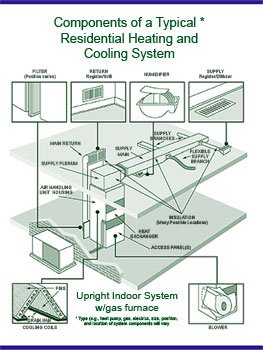
Duct cleaning generally refers to the cleaning of various heating and cooling organisation components of forced air systems, including the supply and return air ducts and registers, grilles and diffusers, heat exchangers heating and cooling coils, condensate bleed pans (baste pans), fan motor and fan housing, and the air handling unit housing (See diagram).
If not properly installed, maintained and operated, these components may go contaminated with particles of dust, pollen or other debris. If moisture is present, the potential for microbiological growth (due east.thou., mold) is increased and spores from such growth may be released into the home's living space. Some of these contaminants may cause allergic reactions or other symptoms in people if they are exposed to them. If yous decide to accept your heating and cooling organization cleaned, it is important to make sure the service provider agrees to make clean all components of the system and is qualified to do so. Failure to clean a component of a contaminated arrangement can consequence in re-contamination of the unabridged organization, thus negating any potential benefits. Methods of duct cleaning vary, although standards have been established by industry associations concerned with air duct cleaning. Typically, a service provider will apply specialized tools to dislodge dirt and other debris in ducts, then vacuum them out with a high-powered vacuum cleaner.
In addition, the service provider may propose applying chemical biocides, designed to kill microbiological contaminants, to the inside of the duct work and to other organization components. Some service providers may also suggest applying chemical treatments (sealants or other encapsulants) to encapsulate or cover the inside surfaces of the air ducts and equipment housings because they believe information technology volition command mold growth or preclude the release of clay particles or fibers from ducts. These practices have yet to be fully researched and you should be fully informed before deciding to permit the employ of biocides or chemical treatments in your air ducts. They should only be applied, if at all, after the system has been properly cleaned of all visible dust or debris.
Notation: Use of sealants to encapsulate the inside surfaces of ducts is a different practice than sealing duct air leaks. Sealing duct air leaks can help relieve energy on heating and cooling bills. For more information, see EPA'southward Energy Star website.
Deciding Whether or Not to Accept Your Air Ducts Cleaned
Noesis virtually the potential benefits and possible problems of air duct cleaning is limited. Since weather in every home are dissimilar, it is impossible to generalize near whether or non air duct cleaning in your home would be beneficial.
If no one in your household suffers from allergies or unexplained symptoms or illnesses and if, afterwards a visual inspection of the inside of the ducts, you see no indication that your air ducts are contaminated with big deposits of dust or mold (no musty olfactory property or visible mold growth), having your air ducts cleaned is probably unnecessary. Information technology is normal for the render registers to get dusty as dust-laden air is pulled through the grate. This does not signal that your air ducts are contaminated with heavy deposits of grit or debris; the registers can be easily vacuumed or removed and cleaned.
On the other hand, if family members are experiencing unusual or unexplained symptoms or illnesses that y'all recollect might be related to your home environment, y'all should hash out the situation with your doctor. EPA has published the following publications for guidance on identifying possible indoor air quality bug and ways to preclude or fix them.
- Indoor Air Quality: An Introduction for Wellness Professionals
- The Inside Story: A Guide to Indoor Air Quality
You may consider having your air ducts cleaned just because it seems logical that air ducts will get dirty over time and should occasionally be cleaned. While the debate about the value of periodic duct cleaning continues, no evidence suggests that such cleaning would be detrimental, provided that information technology is washed properly.
On the other hand, if a service provider fails to follow proper duct cleaning procedures, duct cleaning can crusade indoor air problems. For example, an inadequate vacuum collection organization tin release more dust, dirt and other contaminants than if you had left the ducts alone. A devil-may-care or inadequately trained service provider can damage your ducts or heating and cooling system, possibly increasing your heating and ac costs or forcing you lot to undertake difficult and plush repairs or replacements.
You should consider having the air ducts in your abode cleaned if:
At that place is substantial visible mold growth inside hard surface (e.g., canvass metallic) ducts or on other components of your heating and cooling arrangement. There are several of import points to sympathize concerning mold detection in heating and cooling systems:
- Many sections of your heating and cooling system may not be accessible for a visible inspection, then ask the service provider to show you any mold they say exists.
- You should be aware that although a substance may look similar mold, a positive determination of whether it is mold or non can be made only by an expert and may require laboratory analysis for final confirmation. For about $50, some microbiology laboratories can tell you whether a sample sent to them on a clear strip of gummy household record is mold or simply a substance that resembles it.
- If y'all have insulated air ducts and the insulation gets moisture or moldy it cannot be effectively cleaned and should exist removed and replaced.
- If the atmospheric condition causing the mold growth in the offset place are non corrected, mold growth will recur.
Ducts are infested with vermin, due east.grand. (rodents or insects)
Ducts are chock-full with excessive amounts of dust and droppings and/or particles are actually released into the home from your supply registers.
Other Important Considerations
Duct cleaning has never been shown to actually prevent health problems. Neither practise studies conclusively demonstrate that particle (e.g., dust) levels in homes increase because of dirty air ducts or go downwards after cleaning. This is because much of the dirt that may accumulate inside air ducts adheres to duct surfaces and does not necessarily enter the living space. It is of import to keep in listen that dirty air ducts are but one of many possible sources of particles that are present in homes. Pollutants that enter the home both from outdoors and indoor activities such every bit cooking, cleaning, smoking, or only moving effectually can cause greater exposure to contaminants than dirty air ducts. Moreover, there is no show that a light corporeality of household dust or other particulate matter in air ducts poses whatsoever chance to health.
EPA does not recommend that air ducts exist cleaned except on an every bit-needed basis because of the continuing doubt about the benefits of duct cleaning under most circumstances. EPA does, however, recommend that if you lot have a fuel burning furnace, stove, or fireplace, they exist inspected for proper operation and serviced earlier each heating season to protect against carbon monoxide poisoning. Some enquiry also suggests that cleaning dirty cooling coils, fans and heat exchangers tin can improve the efficiency of heating and cooling systems. Withal, lilliputian evidence exists to indicate that but cleaning the duct organisation will increment your system'due south efficiency.
If you think duct cleaning might be a skilful thought for your home, but you are non sure, talk to a professional person. The visitor that services your heating and cooling system may be a expert source of advice. You may also want to contact professional person duct cleaning service providers and ask them well-nigh the services they provide. Call up, they are trying to sell yous a service, then ask questions and insist on complete and knowledgeable answers.
Suggestions for Choosing a Duct Cleaning Service Provider
To find companies that provide duct cleaning services, check your Yellow Pages nether "duct cleaning" or contact the National Air Duct Cleaners Clan (NADCA) at the address and phone number in the information section located at the end of this guidance. Do non assume that all duct cleaning service providers are equally knowledgeable and responsible. Talk to at least three unlike service providers and become written estimates before deciding whether to have your ducts cleaned. When the service providers come to your abode, enquire them to show you the contamination that would justify having your ducts cleaned.
Do non hire duct cleaners who brand sweeping claims nearly the health benefits of duct cleaning — such claims are unsubstantiated. Do not rent duct cleaners who recommend duct cleaning as a routine part of your heating and cooling system maintenance. You should likewise be wary of duct cleaners who claim to be certified past EPA. Note: EPA neither establishes duct cleaning standards nor certifies, endorses, or approves duct cleaning companies.
Do not allow the use of chemical biocides or chemical treatments unless you fully understand the pros and the cons (Run into "Unresolved Issues of Duct Cleaning).
Check references to be certain other customers were satisfied and did not experience any problems with their heating and cooling system after cleaning.
Contact your county or city role of consumer diplomacy or local Better Business Bureau to determine if complaints take been lodged confronting whatsoever of the companies yous are because.
Interview potential service providers to ensure:
- they are experienced in duct cleaning and accept worked on systems like yours;
- they will use procedures to protect you, your pets and your home from contamination; and
- they comply with NADCA's air duct cleaning standards and, if your ducts are constructed of cobweb glass duct lath or insulated internally with fiber drinking glass duct liner, with the North American Insulation Manufacturers Clan's (NAIMA) recommendations.
Ask the service provider whether they hold whatever relevant state licenses. As of 1996, the post-obit states require air duct cleaners to hold special licenses: Arizona, Arkansas, California, Florida, Georgia, Michigan and Texas. Other states may require them also.
If the service provider charges past the 60 minutes, asking an estimate of the number of hours or days the task will take, and discover out whether at that place will be interruptions in the work. Make sure the duct cleaner you lot cull will provide a written understanding outlining the total toll and scope of the job before work begins.
What to Wait From an Air Duct Cleaning Service Provider
If you choose to have your ducts cleaned, the service provider should:
Open admission ports or doors to allow the entire system to be cleaned and inspected.
Inspect the system before cleaning to be certain that there are no asbestos-containing materials (e.yard., insulation, annals boots, etc.) in the heating and cooling system. Asbestos-containing materials require specialized procedures and should non exist disturbed or removed except past specially trained and equipped contractors.
Use vacuum equipment that exhausts particles outside of the habitation or utilise simply high-efficiency particle air (HEPA) vacuuming equipment if the vacuum exhausts inside the home.
Protect carpet and household furnishings during cleaning.
Use well-controlled brushing of duct surfaces in conjunction with contact vacuum cleaning to dislodge dust and other particles.
Use only soft-bristled brushes for fiberglass duct board and sheet metal ducts internally lined with fiberglass. (Although flex duct tin besides be cleaned using soft-bristled brushes, information technology tin exist more economical to just supersede accessible flex duct.)
Have care to protect the duct work, including sealing and re-insulating any admission holes the service provider may have made or used so they are airtight.
Follow NADCA's standards for air duct cleaning and NAIMA's recommended practice for ducts containing fiber glass lining or synthetic of cobweb glass duct board.
How to Determine if the Duct Cleaner Did A Thorough Task
A thorough visual inspection is the best manner to verify the cleanliness of your heating and cooling arrangement. Some service providers use remote photography to certificate weather condition inside ducts. All portions of the system should exist visibly clean; you should not be able to observe whatsoever debris with the naked eye. Show the Mail-Cleaning Consumer Checklist to the service provider earlier the work begins. Afterwards completing the job, ask the service provider to show you each component of your system to verify that the job was performed satisfactorily.
If you respond "No" to any of the questions on the checklist, this may indicate a trouble with the task. Ask your service provider to correct whatsoever deficiencies until you can answer "yes" to all the questions on the checklist.
| Post Cleaning Consumer Checklist | Yes | No | |
|---|---|---|---|
| General | Did the service provider obtain access to and clean the entire heating and cooling organization, including ductwork and all components (drain pans, humidifiers, coils and fans)? | ||
| Has the service provider adequately demonstrated that duct work and plenums are make clean? (Plenum is a space in which supply or return air is mixed or moves; can be duct, joist infinite, attic and crawl spaces, or wall cavity.) | |||
| Heating | Is the oestrus exchanger surface visibly make clean? | ||
| Cooling Components | Are both sides of the cooling coil visibly clean? | ||
| If you lot point a flashlight into the cooling curl, does light shine through the other side? Information technology should if the coil is clean. | |||
| Are the whorl fins directly and evenly spaced (as opposed to being bent over and smashed together)? | |||
| Is the coil drain pan completely make clean and draining properly? | |||
| Blower | Are the blower blades clean and free of oil and debris? | ||
| Is the blower compartment costless of visible dust or debris? | |||
| Plenums | Is the return air plenum costless of visible dust or debris? | ||
| Do filters fit properly and are they the proper efficiency as recommended by HVAC organization manufacturer? | |||
| Is the supply air plenum (directly downstream of the air treatment unit) free of moisture stains and contaminants? | |||
| Metal Ducts | Are interior ductwork surfaces free of visible debris? (Select several sites at random in both the render and supply sides of the system.) | ||
| Fiber Glass | Is all fiber drinking glass material in practiced condition (i.east., free of tears and abrasions; well adhered to underlying materials)? | ||
| Access Doors | Are newly installed access doors in sheet metal ducts attached with more than than just duct tape (eastward.thousand., screws, rivets, mastic, etc.)? | ||
| With the system running, is air leakage through access doors or covers very slight or non-existent? | |||
| Air Vents | Accept all registers, grilles and diffusers been firmly reattached to the walls, floors and/or ceilings? | ||
| Are the registers, grilles and diffusers visibly clean? | |||
| System Operation | Does the system function properly in both the heating and cooling modes later on cleaning? | ||
How to Prevent Duct Contagion
Whether or non you decide to have the air ducts in your home cleaned, committing to a good preventive maintenance program is essential to minimize duct contamination.
To prevent dirt from entering the system:
Use the highest efficiency air filter recommended by the manufacturer of your heating and cooling arrangement.
Change filters regularly.
If your filters get clogged, change them more frequently.
Be sure you do not have any missing filters and that air cannot bypass filters through gaps effectually the filter holder.
When having your heating and cooling arrangement maintained or checked for other reasons, exist sure to enquire the service provider to clean cooling coils and drain pans.
During construction or renovation work that produces dust in your home, seal off supply and render registers and do not operate the heating and cooling system until afterwards cleaning up the dust.
Remove grit and vacuum your abode regularly. (Use a high efficiency vacuum (HEPA) cleaner or the highest efficiency filter bags your vacuum cleaner can take. Vacuuming tin can increase the amount of dust in the air during and afterwards vacuuming equally well as in your ducts).
If your heating system includes in-duct humidification equipment, be sure to operate and maintain the humidifier strictly as recommended by the manufacturer.
Whether of non you make up one's mind to have the air ducts in your home cleaned, committing to a skilful preventive maintenance program is essential to minimize duct contagion.
To prevent ducts from condign wet:
Moisture should not be present in ducts. Controlling moisture is the most constructive style to prevent biological growth in air ducts.
Moisture can enter the duct arrangement through leaks or if the arrangement has been improperly installed or serviced. Inquiry suggests that condensation (which occurs when a surface temperature is lower than the dew indicate temperature of the surrounding air) on or most cooling coils of air conditioning units is a major factor in wet contamination of the system. The presence of condensation or loftier relative humidity is an important indicator of the potential for mold growth on any type of duct. Controlling moisture can often be difficult, but hither are some steps y'all can take:
Promptly and properly repair any leaks or water damage.
Pay particular attention to cooling coils, which are designed to remove h2o from the air and can be a major source of moisture contamination of the system that can atomic number 82 to mold growth. Make sure the condensate pan drains properly. The presence of substantial standing h2o and/or debris indicates a problem requiring immediate attention. Check any insulation near cooling coils for wet spots.
Make certain ducts are properly sealed and insulated in all non-air-conditioned spaces (e.chiliad., attics and crawl spaces). This will help to forbid moisture due to condensation from entering the system and is of import to make the system piece of work as intended. To prevent water condensation, the heating and cooling system must be properly insulated.
If you are replacing your air-conditioning system, make certain that the unit is the proper size for your needs and that all ducts are sealed at the joints. A unit of measurement that is also big will cycle on and off frequently, resulting in poor moisture removal, particularly in areas with loftier humidity. Also make sure that your new organization is designed to manage condensation effectively.
Unresolved Issues of Duct Cleaning
Does duct cleaning prevent health problems?
The bottom line is: no one knows. There are examples of ducts that accept become badly contaminated with a variety of materials that may pose risks to your health. The duct organization tin serve as a means to distribute these contaminants throughout a dwelling. In these cases, duct cleaning may make sense. Even so, a calorie-free amount of household dust in your air ducts is normal. Duct cleaning is not considered to be a necessary part of yearly maintenance of your heating and cooling system, which consists of regular cleaning of drain pans and heating and cooling coils, regular filter changes and yearly inspections of heating equipment. Research continues in an effort to evaluate the potential benefits of air duct cleaning.
In the concurrently
Brainwash yourself nearly duct cleaning by contacting some or all of the sources of information listed at the end of this publication and asking questions of potential service providers.
Are duct materials other than bare sheet metal ducts more than probable to exist contaminated with mold and other biological contaminants?
You may be familiar with air ducts that are constructed of sheet metal. Even so, many modern residential air duct systems are constructed of fiber glass duct board or sheet metallic ducts that are lined on the within with fiber drinking glass duct liner. Since the early 1970's, a significant increase in the use of flexible duct, which mostly is internally lined with plastic or some other type of material, has occurred.
The use of insulated duct cloth has increased due:
- to improved temperature control
- free energy conservation
- reduced condensation
Internal insulation provides better acoustical (noise) control. Flexible duct is very low price. These products are engineered specifically for use in ducts or as ducts themselves, and are tested in accordance with standards established by Underwriters Laboratories (UL), the American Society for Testing and Materials (ASTM), and the National Burn Protection Clan (NFPA). Many insulated duct systems have operated for years without supporting meaning mold growth. Keeping them reasonably make clean and dry is generally acceptable. However, there is substantial argue well-nigh whether porous insulation materials (due east.g., cobweb glass) are more decumbent to microbial contamination than bare sheet metal ducts. If enough clay and moisture are permitted to enter the duct system, there may be no significant difference in the rate or extent of microbial growth in internally lined or bare sheet metal ducts. However, treatment of mold contagion on bare sail metallic is much easier. Cleaning and treatment with an EPA-registered biocide are possible. In one case fiberglass duct liner is contaminated with mold, cleaning is not sufficient to prevent re-growth and there are no EPA-registered biocides for the handling of porous duct materials. EPA, NADCA and NAIMA all recommend the replacement of wet or moldy fiber drinking glass duct material.
In the meantime
Experts practice agree that moisture should non be nowadays in ducts and if wet and dirt are present, the potential exists for biological contaminants to grow and be distributed throughout the home. Controlling moisture is the most effective way to prevent biological growth in all types of air ducts.
Correct whatever water leaks or standing water.
Remove standing water nether cooling coils of air handling units by making sure that drain pans slope toward the drain.
If humidifiers are used, they must be properly maintained.
Air handling units should be constructed so that maintenance personnel have piece of cake, directly access to heat exchange components and drain pans for proper cleaning and maintenance.
Fiber drinking glass, or whatsoever other insulation textile that is wet or visibly moldy (or if an unacceptable scent is present) should be removed and replaced by a qualified heating and cooling system contractor.
Steam cleaning and other methods involving moisture should not be used on any kind of duct piece of work.
Should chemical biocides be applied to the within of air ducts?
Air duct cleaning service providers may tell you that they demand to apply a chemical biocide to the within of your ducts to impale bacteria (germs) and fungi (mold), and prevent future biological growth. Some duct cleaning service providers may propose to introduce ozone to impale biological contaminants. Ozone is a highly reactive gas that is regulated in the outside air as a lung irritant. Yet, there remains considerable controversy over the necessity and wisdom of introducing chemical biocides or ozone into the duct work.
Among the possible issues with biocide and ozone application in air ducts:
- Footling research has been conducted to demonstrate the effectiveness of most biocides and ozone when used inside ducts. Simply spraying or otherwise introducing these materials into the operating duct arrangement may cause much of the material to exist transported through the organization and released into other areas of your domicile.
- Some people may react negatively to the biocide or ozone, causing agin wellness reactions.
Chemical biocides are regulated by EPA under Federal pesticide law. A product must be registered past EPA for a specific use earlier it tin can exist legally used for that purpose. The specific use(s) must appear on the pesticide (e.grand., biocide) label, along with other important information. Information technology is a violation of federal constabulary to utilize a pesticide product in whatever mode inconsistent with the label directions.
A pocket-sized number of products are currently registered by EPA specifically for utilize on the inside of bare sheet metal air ducts. A number of products are also registered for utilise equally sanitizers on hard surfaces, which could include the interior of bare sail metal ducts. While many such products may be used legally inside of unlined ducts if all characterization directions are followed, some of the directions on the characterization may be inappropriate for use in ducts. For example, if the directions indicate "rinse with water", the added moisture could stimulate mold growth.
All of the products discussed above are registered solely for the purpose of sanitizing the smooth surfaces of unlined (bare) canvass metal ducts. No products are currently registered as biocides for use on fiber glass duct board or fiber glass lined ducts, then it is important to determine if sections of your system contain these materials earlier permitting the application of any biocide.
In the concurrently
Before allowing a service provider to employ a chemical biocide in your duct work, the service provider should:
Demonstrate visible show of microbial growth in your duct work. Some service providers may endeavour to convince yous that your air ducts are contaminated by demonstrating that the microorganisms found in your home grow on a settling plate (i.e., petri dish). This is inappropriate. Some microorganisms are always present in the air, and some growth on a settling plate is normal. Equally noted earlier, only an adept tin can positively identify a substance as biological growth and lab analysis may be required for final confirmation. Other testing methods are not reliable.
Explain why biological growth cannot exist removed by concrete means, such every bit brushing, and farther growth prevented past decision-making moisture.
If you decide to permit the use of a biocide, the service provider should:
Bear witness you lot the biocide label, which volition draw its range of approved uses.
Apply the biocide simply to un-insulated areas of the duct system subsequently proper cleaning, if necessary to reduce the chances for re-growth of mold.
Always use the product strictly according to its label instructions.
While some low toxicity products may exist legally applied while occupants of the home are present, you may wish to consider leaving the premises while the biocide is being practical as an added precaution.
Do sealants foreclose the release of dust and clay particles into the air?
Manufacturers of products marketed to coat and encapsulate duct surfaces claim that these sealants prevent dust and clay particles inside air ducts from beingness released into the air. As with biocides, a sealant is often applied by spraying it into the operating duct system. Laboratory tests betoken that materials introduced in this mode tend not to completely coat the duct surface. Application of sealants may also touch on the acoustical (noise) and burn retarding characteristics of fiber drinking glass lined or constructed ducts and may invalidate the manufacturer'southward warranty.
Questions nigh the safety, effectiveness and overall desirability of sealants remain. For case, picayune is known about the potential toxicity of these products under typical use weather or in the outcome they grab fire.
In addition, sealants accept yet to be evaluated for their resistance to deterioration over fourth dimension which could add together particles to the duct air.
In the concurrently
Virtually organizations concerned with duct cleaning, including EPA, NADCA, NAIMA and the Sheet Metal and Air conditioning Contractors' National Clan (SMACNA) do not currently recommend the routine employ of sealants to encapsulate contaminants in any blazon of duct. Instances when the use of sealants to encapsulate the duct surfaces may be appropriate include the repair of damaged fiber glass insulation or when combating burn impairment within ducts. Sealants should never be used on wet duct liner, to encompass actively growing mold, or to cover debris in the ducts, and should only be applied later on cleaning according to NADCA or other appropriate guidelines or standards.
To Learn More Virtually Indoor Air Quality
U.S. Environmental Protection Agency
Function of Radiations and Indoor Air
Indoor Environments Partitioning (6609J)
1200 Pennsylvania Avenue, N.W.
Washington, DC 20460
The following EPA publications are bachelor on this web site, some can be ordered from NSCEP. (see also: Publications and Resources)
- The Inside Story: A Guide to Indoor Air Quality
- Indoor Air Pollution: An Introduction for Health Professionals
- Guide to Air Cleaners in the Abode
- Ozone Generators that are Sold as Air Cleaners
To Larn More Nearly Air Duct Cleaning
National Air Duct Cleaners Association (NADCA)
1120 Route 73, Suite 200
Mt. Laurel, NJ 08054
Phone: (855) Go-NADCA • (856) 380-6810
Email: info@nadca.com
Website: NADCA
Detect a NADCA professional duct cleaner nigh you.
North American Insulation Manufacturers Association (NAIMA)
44 Culvert Center Plaza, Suite 310, Alexandria, VA 22314
Telephone: (703) 684-0084
Website: NAIMA
Website: NAIMA Member Company Listing
"Cleaning Gristly Glass Insulated Air Duct Systems; Recommended Practice", NAIMA Pub. No. AH122, xl pages (Toll is $seven.50 for a printed version, no costless copies available.)
Other Useful Resources
For a gratuitous list of land consumer protection offices:
State Consumer Protection Offices
For more information on biocides:
Antimicrobial Data Hotline
Telephone: (703) 308-0127 / Fax: (703) 308-6467
Monday-Fri 8:00 AM - five:00 PM EST
E-post: Info_Antimicrobial@epa.gov
Website: Regulating Antimicrobial Pesticides
The Antimicrobials Information Hotline provides answers to questions apropos current antimicrobial issues (disinfectants, fungicides, others) regulated past the pesticide law, rules and regulations. These cover interpretation laws, rules and regulations, and registration and re-registration of antimicrobial chemicals and products. The Hotline likewise provide data health & safety issues on registered antimicrobial products, product label and the proper and safe use of these antimicrobial products.
Consumer Checklist
Acquire as much equally possible most air duct cleaning before you decide to have your ducts cleaned by reading this guidance and contacting the sources of data provided.
Consider other possible sources of indoor air pollution beginning if you suspect an indoor air quality problem exists in your abode.
Have your air ducts cleaned if they are visibly contaminated with substantial mold growth, pests or vermin, or are clogged with substantial deposits of dust or droppings.
Enquire the service provider to bear witness you any mold or other biological contagion they say exists. Get laboratory confirmation of mold growth or decide to rely on your ain judgment and common sense in evaluating apparent mold growth.
Get estimates from at least three service providers.
Check references.
Inquire the service provider whether he/she holds any relevant state licenses. As of 1996, the following states require air duct cleaners to concur special licenses: Arizona, Arkansas, California, Florida, Georgia, Michigan and Texas. Other states may also require licenses.
Insist that the service provider give you knowledgeable and consummate answers to your questions.
Discover out whether your ducts are made of canvas metallic, flex duct, or constructed of fiber glass duct board or lined with fiber glass since the methods of cleaning vary depending on duct type. Remember, a combination of these elements may be present.
Permit the awarding of biocides in your ducts only if necessary to control mold growth and only after assuring yourself that the product will be applied strictly according to label directions. As a precaution, yous and your pets should exit the premises during awarding.
Do non permit the use of sealants except under unusual circumstances where other alternatives are not feasible.
Commit to a preventive maintenance program of yearly inspections of your heating and cooling system, regular filter changes, and steps to prevent wet contamination.

Source: https://www.epa.gov/indoor-air-quality-iaq/should-you-have-air-ducts-your-home-cleaned
Posted by: bowdenheman1981.blogspot.com
0 Response to "Can You Clean Your Air Ducts Yourself"
Post a Comment